
Claude Certified Architect – Foundations (CCAR-F): Scored 977 Points

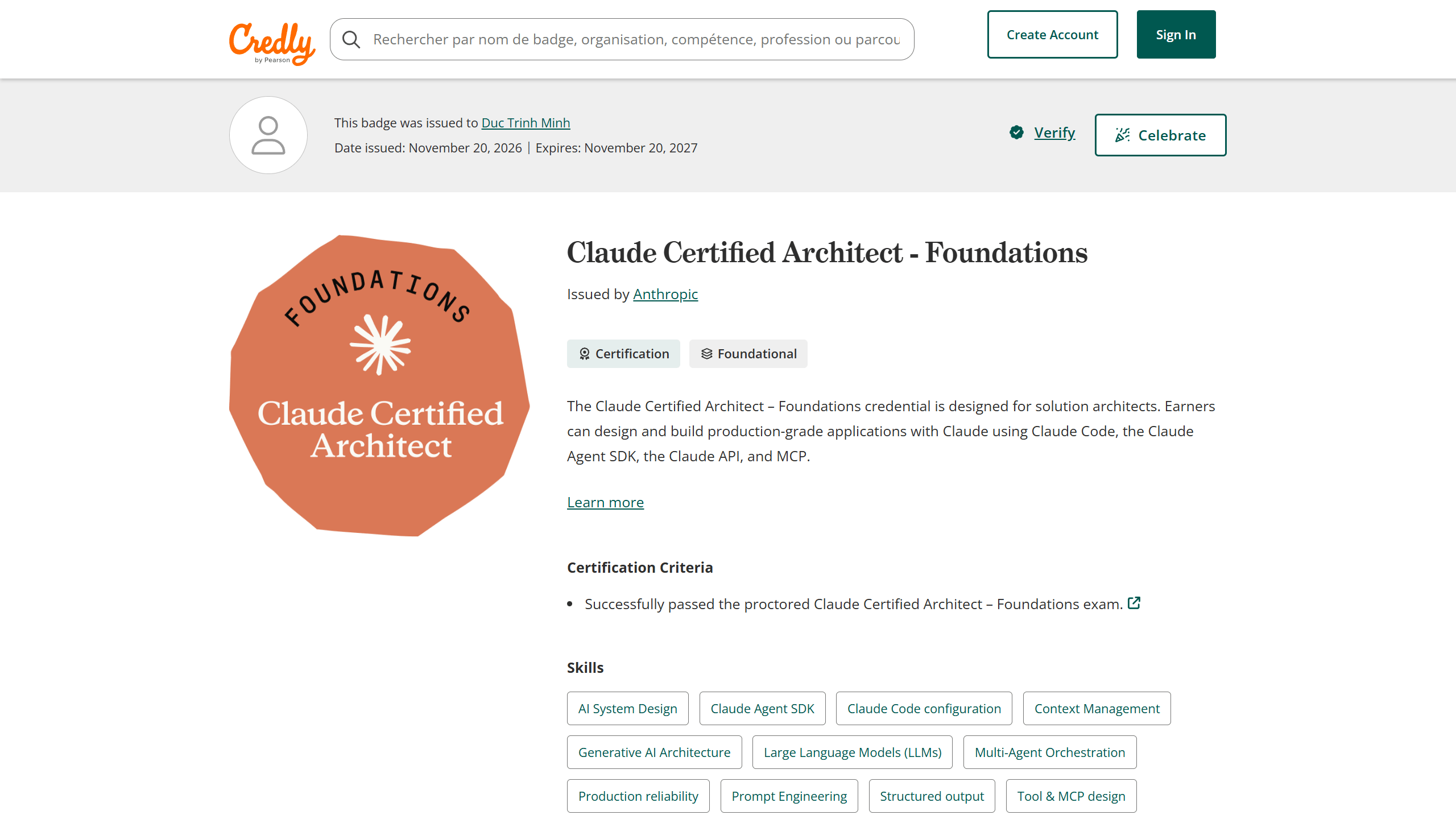
Table of Contents
My Experience Scoring 977 on the Claude Certified Architect – Foundations (CCAR-F) Exam: Study Plan, Key Topics, and Practical Lessons
Topics: Anthropic, Claude AI, AI Agent, Claude Code, MCP, AI Architecture
Result: 977/1000 points
Target Audience: Solution Architects, DevOps Engineers, Cloud Engineers, AI Engineers, and Developers
1. Introduction
After earning the Claude Certified Associate – Foundations (CCAO-F) certification with a perfect score of 1000/1000, I continued exploring Anthropic’s Claude ecosystem and recently completed the Claude Certified Architect – Foundations (CCAR-F) certification with a score of 977/1000.

While CCAO-F helps build a foundation in using Claude, CCAR-F offers a deeper perspective on designing, deploying, and operating AI applications in real-world environments.
The biggest difference I noticed is that the exam doesn’t simply test your ability to memorize concepts or API syntax. Most scenarios require you to understand how systems actually work, identify the root cause of a problem, and choose an appropriate architectural solution.
For example:
- When an AI Agent repeatedly selects the wrong tool, should you improve the prompt, change the tool description, or redesign the toolset?
- When a tool returns an error, how can the Agent distinguish between a temporary failure and a business logic error?
- How do you maintain context across conversations that span dozens of turns?
- When should an AI Agent hand control over to a human?
- How can you ensure mandatory policies are always enforced instead of relying solely on prompts?
- How should CLAUDE.md, Skills, Rules, and Hooks be organized effectively in large projects?
These are also common challenges when moving AI Agents from the Proof of Concept (PoC) stage into Production.
In this article, I’ll summarize the topics I studied, lessons learned from taking the exam, and several representative technical scenarios. I hope this contributes to the DevOps VietNam community and gives everyone some practical reference material.
Note: This article shares my personal experience. It is not official Anthropic documentation or a collection of actual exam questions. The example scenarios have been reworded for educational purposes.
2. What Is Claude Certified Architect – Foundations (CCAR-F)?
Claude Certified Architect – Foundations is a technical certification in Anthropic’s certification ecosystem, designed for professionals who build and deploy applications using Claude.
The certification is particularly relevant to:
- Solution Architect / AI Architect
- AI Engineer / Agent Developer
- DevOps Engineer / Platform Engineer
- Cloud Engineer
- Software Engineer
- Technical Lead
Unlike simply using Claude for questions and answers or content generation, an AI Architect needs to understand how to integrate language models into software systems and control the entire processing lifecycle.
An enterprise AI application involves more than just a language model. It also includes:
User → Application → Claude API → Tools/MCP → Backend Systems → Business Logic → Response
In this architecture, Claude handles reasoning and proposes actions, while the application is responsible for orchestration, tool execution, state management, authentication, and enforcing business constraints.
This is an important distinction between building a conventional chatbot and developing an AI Agent system capable of operating in real-world environments.
3. Key Knowledge Areas to Focus on
Based on my preparation and the types of scenarios I encountered, I organized my study materials into six main areas.
| Knowledge Area | Key Topics |
|---|---|
| Agentic Architecture | Agentic Loop, Tool Use, workflow orchestration |
| Tool Design & MCP | Tool design, MCP Server, Tool Selection |
| Error Handling | Error Classification, Retry, Recovery |
| Context Management | Conversation History, State, Context Window |
| Claude Code | CLAUDE.md, Rules, Skills, Hooks, Plan Mode |
| Reliability & Safety | Human-in-the-loop, Escalation, Guardrails |
This is how I personally organized the material for studying. It does not represent the official exam domains or their weightings.
4. Agentic Architecture – Understanding How AI Agents Work
4.1. What Is an Agentic Loop?
An Agentic Loop is a mechanism that allows an AI Agent to perform multiple consecutive steps to complete a request.
Instead of simply responding based on existing knowledge, an Agent can:
- Analyze the user’s request.
- Identify additional information it needs.
- Select an appropriate tool.
- Call the tool and receive its results.
- Evaluate the results.
- Continue calling tools or provide a final response.
For example, suppose a customer requests a refund for an order.
The Agent may need to perform the following operations:
Customer Request
       |
       v
get_customer
       |
       v
lookup_order
       |
       v
Check Refund Eligibility
       |
       +---- Eligible ----> process_refund
       |
       +---- Exception ---> escalate_to_human
       |
       v
Customer Response
The important point is that the Agent doesn’t necessarily follow a fixed sequence of tool calls.
After receiving each result, the model can reassess the situation and decide what to do next.
4.2. Controlling the Agentic Loop
When using the Claude Messages API, the application needs to check the stop_reason field in the response.
Two values are particularly important:
tool_use: Claude is requesting the execution of one or more tools.end_turn: Claude has completed its response turn.
For example:
while True:
    response = call_claude(messages, tools)

    if response.stop_reason == "tool_use":
        results = execute_requested_tools(response)
        append_assistant_and_tool_results(
            messages, response, results
        )
        continue

    if response.stop_reason == "end_turn":
        return response

    handle_other_stop_reasons(response)
In a real-world implementation, you also need to handle other stop reasons, limits on the number of tool calls, timeouts, and failures from external systems.
Lesson learned: Don’t assume an Agent has finished just because its response contains text. A single response may contain both text and a request to call a tool.
5. Tool Design & MCP – Designing Tools for AI Agents
5.1. What Is MCP?
Model Context Protocol (MCP) is an open protocol that enables AI applications to connect to external tools and data sources through a standardized interface.
An MCP Server can provide:
- Tools: Operations that an Agent can perform.
- Resources: Data or resources that an application can access.
- Prompts: Predefined prompt templates.
For example, in an infrastructure management system, an MCP Server might provide tools such as:
get_ec2_status
get_cloudwatch_metrics
lookup_incident
get_change_request
create_change_request
An AI Agent can use these tools to gather information, investigate incidents, or recommend actions.
However, not every tool should be available for automatic execution by an Agent.
High-impact operations such as deleting resources, modifying access permissions, or deploying to Production require appropriate controls.
5.2. How Important Are Tool Descriptions?
One interesting scenario involves an Agent that has access to process_refund but invents a nonexistent order_id instead of calling lookup_order first.
The problem may be that the tool description doesn’t clearly explain its prerequisites.
For example, a poor description:
process_refund:
Processes a refund for an order.
A better description:
process_refund:
Processes a refund for an existing order.

The order_id must be obtained from a
successful lookup_order result.

Never invent or assume an order_id.
The second description helps the Agent understand the relationship between the tools.
However, remember that tool descriptions only help guide behavior. The backend must still validate the order_id, access permissions, and refund eligibility before executing the transaction.
5.3. When the Number of Tools Increases
An Agent with too many tools that perform similar functions may struggle to select the right one.
For example:
process_refund
issue_credit
apply_discount
lookup_order
check_delivery_status
If process_refund and issue_credit have overlapping responsibilities, the Agent may choose incorrectly.
There are several ways to improve this.
First, define clear functional boundaries.
Each tool should have a well-defined purpose, inputs, and outputs.
Second, consolidate tools that genuinely duplicate one another.
For example, you could design a compensation-handling tool with an action parameter:
{
  "action": "refund",
  "order_id": "ORD-123",
  "amount": 50
}
Third, use tool search or load tools on demand.
This approach is particularly useful when the number of tools becomes large, although it doesn’t automatically solve semantic overlap between tools.
Lesson learned: When an Agent chooses the wrong tool, don’t automatically assume that writing a longer prompt is the best solution. Sometimes the real problem lies in the API design and Tool Schema.
6. Error Handling – One of the Most Important Topics
6.1. Why Do Errors Need to Be Classified?
Suppose an Agent calls process_refund and receives:
{
  "isError": true,
  "message": "Operation failed"
}
This information isn’t enough for the Agent to know what it should do next.
The error could have several causes:
- Network timeout.
- Backend service unavailable.
- Order ID does not exist.
- The order is outside the refund window.
- The user does not have permission to perform the operation.
If every failure returns the same generic message, the Agent may repeatedly retry operations that cannot possibly succeed.
6.2. Structured Error Responses
A better design is to return structured error information.
{
  "isError": true,
  "errorCode": "REFUND_WINDOW_EXPIRED",
  "errorCategory": "business",
  "retryable": false,
  "message": "The order exceeds the refund window",
  "suggestedAction": "Explain policy or escalate"
}
For a temporary infrastructure failure:
{
  "isError": true,
  "errorCode": "SERVICE_TIMEOUT",
  "errorCategory": "transient",
  "retryable": true,
  "message": "Refund service temporarily unavailable",
  "suggestedAction": "Retry with backoff"
}
The errorCategory, retryable, and suggestedAction fields are proposed application-level design choices, not mandatory fields required by every MCP Server.
6.3. Retry and Exponential Backoff
Retries are appropriate for temporary failures, such as:
- HTTP 503 Service Unavailable.
- Network timeout.
- Certain connection errors that may recover.
Retries should not be used for permanent business logic errors, such as:
- The order does not exist.
- The order has already been refunded.
- The refund window has expired.
For retryable errors, you can use Exponential Backoff:
Attempt 1: Immediate
Attempt 2: Wait 1 second
Attempt 3: Wait 2 seconds
Attempt 4: Wait 4 seconds
In Production, you should also add jitter, a maximum retry count, and an overall timeout.
For operations that modify data, especially financial transactions, an idempotency key or an equivalent mechanism is needed to prevent duplicate processing during retries.
Lesson learned: Retry behavior should depend on the nature of the error, not simply on whether a tool reports a failure.
7. Context Management – Managing Context in Long Conversations
A common issue with AI Agents is losing information or using it incorrectly as conversations become longer.
For example, a customer discusses three different issues during one session:
- Turns 1–15: Requests a refund.
- Turns 16–30: Changes their subscription plan.
- Turns 31–45: Updates their payment method.
At turn 48, the customer returns to the original refund request.
If the system only retains the most recent 30 turns, important information may already have been removed from the context.
7.1. Is a Sliding Window Enough?
A Sliding Window approach retains only a certain number of the most recent conversation turns.
Its advantage is simplicity and better control over token usage.
However, this approach risks removing information that is still needed.
7.2. Structured Context
One approach worth considering is storing business state as structured data.
For example:
{
  "customer_id": "CUS-001",
  "issues": [
    {
      "type": "refund",
      "order_id": "ORD-123",
      "status": "pending"
    },
    {
      "type": "subscription",
      "status": "resolved"
    }
  ]
}
When the customer returns, the system can restore the state from stored data instead of relying entirely on conversation history.
7.3. Avoid Using Outdated Tool Results
Another issue occurs when an Agent continues using old tool results.
For example:
10:00 - Refund Status: PENDING
14:00 - Refund Status: COMPLETED
If the system restores the entire old conversation history, the Agent may continue referencing the PENDING status.
A more reliable approach is to:
- Restore a summary of the previous session.
- Retain identifiers and other important business data.
- Call the relevant tool again to retrieve the latest status.
- Prioritize current data from the source system.
Lesson learned: Conversation History is not the same as Business State. Important business information should be managed separately and kept synchronized with the source system.
8. Human-in-the-loop – When Should an Agent Escalate to a Human?
Not every situation should be handled automatically.
For example, a company has the following policy:
Refund transactions exceeding $500 must be approved by an authorized employee.
If you only include this rule in the system prompt, the Agent may still handle certain situations incorrectly.
Therefore, mandatory policies should be enforced through deterministic logic at the application or backend layer.
For example:
def handle_refund(order_id, amount):
    if amount > 500:
        return escalate_to_human(
            order_id=order_id,
            amount=amount
        )

    return process_refund(
        order_id=order_id,
        amount=amount
    )
In a real-world system, policy checks must be enforced at the authoritative execution point before a transaction is committed.
8.1. Situations That Require Escalation
Some common examples include:
- A customer requests to speak with a human representative.
- A transaction exceeds the permitted threshold.
- A request requires an exception to an existing policy.
- The Agent doesn’t have enough information to make a decision.
- The Agent cannot continue processing the request meaningfully.
- A backend system encounters an error that cannot be recovered within the allowed time.
8.2. Structured Handoff
When handing a case over to a human employee, the Agent should provide enough information so the customer doesn’t have to explain everything again.
For example:
{
  "customer_id": "CUS-001",
  "order_id": "ORD-123",
  "issue": "Refund request",
  "amount": 650,
  "reason": "Manager approval required",
  "actions_taken": [
    "Customer verified",
    "Order retrieved",
    "Eligibility checked"
  ]
}
The handoff information must comply with data minimization principles and the organization’s security policies.
Lesson learned: Human-in-the-loop isn’t just a fallback when AI fails. It’s an important component of risk governance architecture.
9. Claude Code – CLAUDE.md, Rules, Skills, and Hooks
This is a particularly relevant knowledge area for DevOps Engineers and Developers.
9.1. CLAUDE.md
CLAUDE.md provides project instructions and context to Claude Code.
For example:
# Project Conventions

- Follow existing project architecture.
- Use 4-space indentation.
- Run tests before completing changes.
- Never commit credentials.
- Follow established error-handling patterns.
However, you shouldn’t put every detailed rule into a single CLAUDE.md file.
For large repositories, instructions should be organized by scope to reduce irrelevant information.
9.2. Path-scoped Rules
Suppose your repository has the following structure:
terraform/
kubernetes/
pipelines/
Each directory has different requirements.
You can organize your rules like this:
.claude/
  rules/
    terraform.md
    kubernetes.md
    pipelines.md
Each file can define the scope in which its rules apply.
For example:
---
paths:
  - "terraform/**/*.tf"
---
You can then add the relevant Terraform rules.
This approach helps Claude Code receive instructions that are more relevant to the types of files it’s working with.
9.3. Hooks – Turning Rules into Automated Actions
A typical example is the requirement:
Always run Prettier before completing code changes.If you only put this instruction in CLAUDE.md, Claude may not follow it consistently.
A better solution is to use a Hook to automatically execute the formatter after a file is modified.
For example, the workflow might look like:
Claude edits file
       |
       v
PostToolUse Hook
       |
       v
Run Prettier
       |
       v
Formatted source code
Hooks are useful for operations that must follow a deterministic process, such as:
- Code formatting.
- Linting.
- Validation.
- Security checks.
- Checking preconditions before executing tools.
Remember to configure Hooks with an appropriate scope so they don’t run commands on files where those commands don’t belong.
9.4. Plan Mode
Plan Mode is particularly useful when making large changes that affect multiple system components.
For example, upgrading an authentication library from an older version to a newer one that introduces API and data structure changes.
Instead of immediately modifying dozens of files, you should:
- Explore the codebase.
- Identify affected modules.
- Analyze breaking changes.
- Create a migration plan.
- Implement the changes step by step.
- Run tests and evaluate the results.
This is an appropriate approach for large-scale code modernization and refactoring tasks.
10. Architecture Scenarios Worth Practicing
When preparing for the exam, I recommend doing more than simply reading documentation. You should also practice analyzing hypothetical scenarios.
Scenario 1: The Agent Repeatedly Selects the Wrong Tool
Problem: Several tools have similar functionality.
What to investigate: Tool Schema, Tool Description, business function boundaries, and opportunities to consolidate tools.
Scenario 2: The Agent Keeps Retrying Business Logic Errors
Problem: The backend returns generic error messages.
What to investigate: Introduce structured errors and distinguish between retryable and non-retryable failures.
Scenario 3: The Agent Forgets Information from Previous Turns
Problem: Conversation history isn’t fully provided, or state hasn’t been persisted.
What to investigate: Conversation history, session state, and business data persistence.
Scenario 4: The Agent Executes a Transaction Beyond Its Authority
Problem: Mandatory rules are enforced only through prompts.
What to investigate: Apply policy enforcement at the backend or orchestration layer.
Scenario 5: The Agent Cannot Finish Before Reaching the Turn Limit
Problem: The workflow is complex and requires many tool calls.
What to investigate: Optimize the process, split the workflow where appropriate, and establish fallback or escalation mechanisms when processing cannot be completed successfully.
Scenario 6: Claude Code Doesn’t Follow Formatting Rules
Problem: Rules written in natural language aren’t consistently followed.
What to investigate: Use Hooks together with a formatter or linter instead of simply emphasizing the instructions more strongly in the prompt.
One principle I’ve found particularly useful when analyzing these scenarios is:
Solve problems at the appropriate architectural layer instead of trying to fix everything with prompts.
11. My Recommended CCAR-F Study Plan
I suggest a 7-day study plan for anyone who already has foundational knowledge of APIs, programming, or Cloud systems.
| Day | Topic | Goal |
|---|---|---|
| 1 | Claude API & Tool Use | Understand request/response structures, tool_use, and tool_result |
| 2 | Agentic Loop | Understand orchestration mechanisms and termination conditions |
| 3 | MCP & Tool Design | Design tools and distinguish their functional responsibilities |
| 4 | Error Handling | Retry, backoff, structured errors, recovery |
| 5 | Context Management | Session state, conversation history, summarization |
| 6 | Claude Code | CLAUDE.md, Rules, Skills, Hooks, Plan Mode |
| 7 | Architecture Scenarios | Practice scenario analysis and consolidate knowledge |
My Study Method
I focus on three steps.
Step 1 – Understand the Fundamentals
Understand the purpose and operating mechanisms of each component.
For example, don’t just memorize what stop_reason means. Understand how an application uses it to control the Agentic Loop.
Step 2 – Compare Different Solutions
For a given problem, try analyzing multiple approaches.
For example:
- Prompt Engineering.
- Tool Description.
- Structured Error.
- Application Logic.
- Backend Validation.
Then determine which solution directly addresses the root cause.
Step 3 – Practice with Scenarios
Build a simple Agent with multiple tools, then simulate:
- Tool timeout.
- Invalid input.
- Business rule violation.
- Context loss.
- Human escalation.
Hands-on practice helps you understand the difference between an Agent that merely works and one that’s reliable enough for real-world deployment.
12. Reference Materials
For exam preparation, I recommend prioritizing Anthropic’s official documentation.
1. Claude API Documentation
Focus on the Messages API, Tool Use, Error Handling, and principles for building applications.
2. Claude Code Documentation
Learn about CLAUDE.md, Rules, Skills, Hooks, MCP, and software development workflows.
3. Model Context Protocol
https://modelcontextprotocol.io/
Understand MCP architecture, Tools, Resources, Prompts, and integration approaches.
4. Anthropic Academy
https://www.anthropic.com/learn
Explore courses and educational resources provided by Anthropic.
5. Claude Partner Network
https://www.anthropic.com/partners
Refer to information about the Partner program and related training and certification opportunities.
For exam preparation materials, make sure to check their current versions and coverage because the Claude API and Claude Code are updated frequently.
13. My Exam-Taking Experience
Based on my personal experience, there are several things worth keeping in mind.
Read the Question’s Objective Carefully
Keywords such as:
- Most effective.
- Most reliable.
- Root cause.
- Guaranteed compliance.
- Structurally eliminates.
- Best approach.
often determine how the answer choices should be evaluated.
For example, if a question requires guaranteed compliance, a solution that only improves the prompt is usually not as strong as mandatory enforcement at the execution layer.
Distinguish Between Treating Symptoms and Addressing Root Causes
If an Agent selects the wrong tool because multiple tools have overlapping functionality, adding examples to the prompt may improve the results.
However, redesigning the boundaries between tools may solve the problem at the architectural level.
Don’t Assume a More Complex Solution Is Always Better
Multi-agent architectures, orchestration layers, or adding more tools are not always necessary.
A good solution must fit the root cause, operational requirements, and level of risk.
Prioritize Safety and Control
For operations that affect data, finances, or Production infrastructure, pay particular attention to:
- Authorization.
- Validation.
- Audit logging.
- Human approval.
- Idempotency.
- Error recovery.
These are all important considerations when designing enterprise AI systems.
14. Applying These Concepts to DevOps, Cloud, and AI Infrastructure
For those working in DevOps, Cloud, or Infrastructure, the knowledge covered by CCAR-F can be applied to many real-world challenges.
AI Agents for Incident Management
An Agent can:
- Receive alerts from monitoring systems.
- Collect metrics and logs.
- Query incident history.
- Cross-reference the Knowledge Base and Runbook.
- Recommend remediation actions.
- Escalate to an engineer for approval when an action carries significant risk.
AI Agents for Change Management
An Agent can help analyze Change Requests, assess their impact, verify deployment prerequisites, and summarize rollback strategies.
However, approval and execution permissions for important changes should remain controlled by governance systems and authorized personnel.
AI Agents for Cloud Operations
Some potential applications include:
- Analyzing CloudWatch Logs and Metrics.
- Assisting with incident investigations involving EC2, ECS, and RDS.
- Analyzing unusual Cloud costs.
- Reviewing configurations and recommending security improvements.
- Helping create and maintain Runbooks.
In my opinion, the greatest value of AI Agents isn’t automating every operation.
It’s their ability to combine AI reasoning, operational data, execution tools, and risk control mechanisms.
This is also a suitable direction for building AIOps and Autonomous Operations platforms in the future.
15. Conclusion
Completing Claude Certified Architect – Foundations with a score of 977/1000 marks another milestone in my journey of learning about and applying AI.
The most valuable outcome of my preparation wasn’t just earning the certification. It was developing a more systematic perspective on building AI Agent applications.
Here are some important lessons I’d like to share:
- AI Agents should be designed as complete software systems, not simply as models combined with prompts.
- Tool Design and MCP play important roles in enabling interaction with external systems.
- Error Handling must be structured and clearly distinguish technical failures from business logic errors.
- Context Management should combine conversation history with business state.
- Mandatory policies must be enforced through deterministic control mechanisms.
- Claude Code can significantly support software development when CLAUDE.md, Rules, Skills, and Hooks are organized appropriately.
- AI Agents should be evaluated based on accuracy, recoverability, safety, and long-term operability.
Moving from using AI effectively to designing AI Agents that can operate reliably in the real world is an important step forward.
I hope this article gives everyone exploring Claude, AI Agents, and AI application architecture some useful perspectives and a clearer direction for exam preparation.
Wishing you productive study sessions and great results on your CCAR-F exam!
Keep Learning – Keep Building – Keep Improving!