
AWS Certified DevOps Engineer: Roadmap, Tips, and Resources

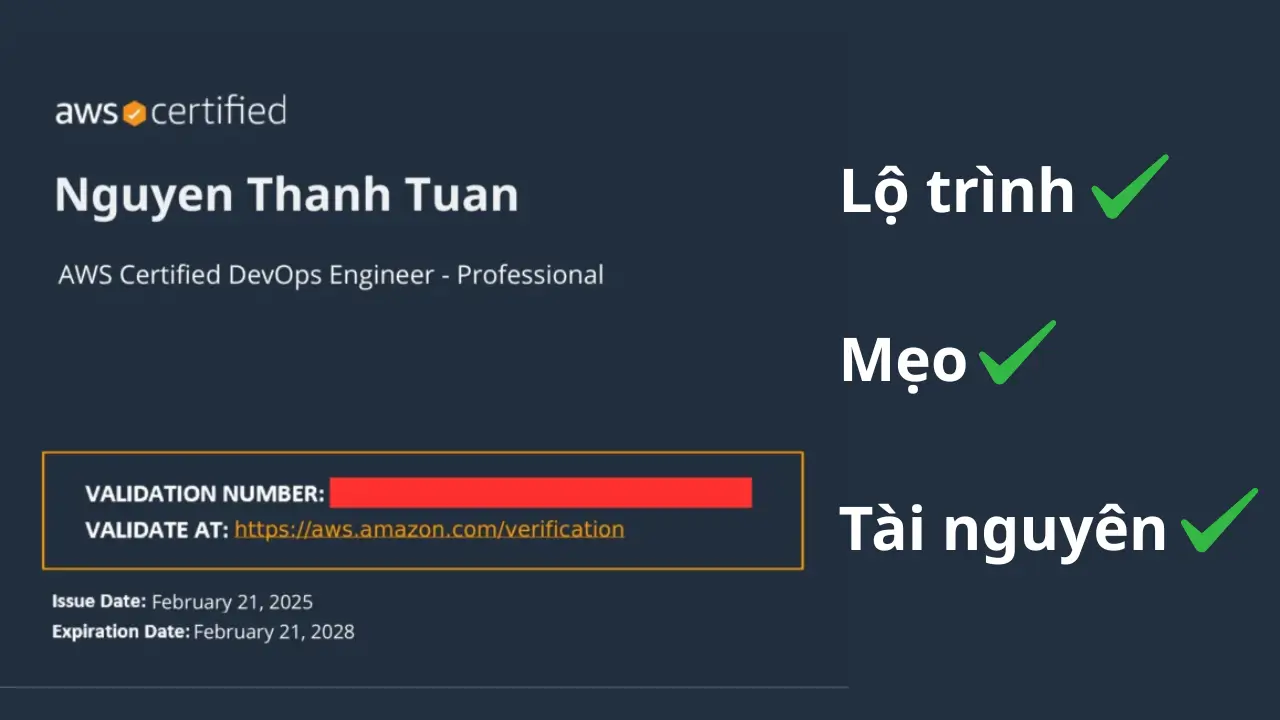
Table of Contents
Hi everyone! I’m just a regular DevOps Engineer who has been working with AWS for quite a few years now 😄. I used to be pretty interested in collecting AWS certifications and have earned “a few” over the years. Most of them are still valid, so I’ve been too lazy to renew them.
One of them, the AWS Certified DevOps Engineer Professional, was quite a tough exam for me back then, although it seems a bit easier now =)). Mine had just expired, so I decided to study again and retake the exam. Fortunately, I successfully renewed it 😄.
Today I want to share my complete set of tips from A to Z to help you confidently tackle this “hot” certification. This article includes my 5-week study roadmap, the resources I used, and the exam tips I picked up along the way. Hopefully, it will be useful to you.

AWS DevOps Engineer Professional (DOP-C02) Exam Information
| Parameter | Details |
|---|---|
| Exam Code | DOP-C02 (Updated in 2023) |
| Duration | 180 minutes |
| Number of Questions | 75 multiple-choice questions & case studies |
| Exam Fee | $300 |
| Passing Score | 750/1000 |
| Format | Pearson VUE testing center or Online Proctored |
Knowledge Areas Covered in the Exam
Below is a summary of the domains covered in the exam:
| Domain | Weight | Topics |
|---|---|---|
| SDLC Automation | 22% | – SDLC concepts – CI/CD pipeline implementation – Automated testing – Artifact creation and management |
| Configuration Management and IaC | 17% | – IaC tools and platforms – Managing AWS accounts in multi-region environments – Developing Lambda automation for complex scenarios |
| Resilient Cloud Solutions | 15% | – Multi-AZ and multi-region deployments – Containerized application deployment (ECS, EKS) – Cross-region backups – Serverless application configuration |
| Monitoring and Logging | 15% | – Amazon CloudWatch Metrics – CloudWatch anomaly detection – Asynchronous event-driven design patterns |
| Incident and Event Response | 14% | – AWS Health, EventBridge, CloudTrail – Systems Manager, AWS Auto Scaling – Amazon SQS, Kinesis, Amazon SNS |
| Security and Compliance | 17% | – Data encryption in transit and at rest – AWS services such as GuardDuty and Amazon Inspector for identifying security vulnerabilities – Identity federation techniques |
Resources
Of course, I couldn’t really avoid Stephane Maarek’s Udemy courses and practice exams 😀.
1. AWS Certified DevOps Engineer Professional 2025 – DOP-C02
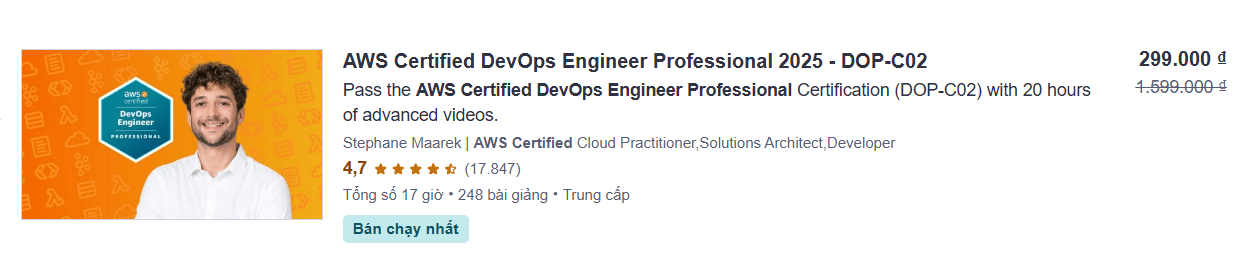
This course provides a structured overview of the knowledge needed for the AWS Certified DevOps Engineer Professional exam. I would say that studying this course alone gives you enough knowledge for the certification.
Enough knowledge, though. You still need practice exams, which brings us to the next resource.
2. Practice Exams | AWS Certified DevOps Engineer Professional

Historically, both the courses and practice exams I’ve used have mostly been from Stephane Maarek. For the AWS Certified Solutions Architect – Professional, I also used some practice exams from Neal Davis.
3. Free Resources
Of course, whether they are perfect or not, there are always free resources available for learning and reference. Here, I’ll focus only on resources from reputable sources such as official vendors, major providers, or large communities.
My 5-Week Study Roadmap
Honestly, if you already work extensively with AWS, you may not need this much time. There are also plenty of “dump” style courses designed purely for passing the exam.
But I’m the type who prefers to play it safe, so I decided to review everything properly and see what had changed over the past few years 😄.
I also wanted to create a roadmap that works from zero for anyone starting out, because I did not write or take notes about my previous attempt. This is also my first article on devops.vn. Before this, I occasionally wrote on Viblo, but it was all over the place 😄.
Week 1: SDLC Automation & Configuration Management
- Goal: Build a solid understanding of CI/CD and configuration management
- Main topics:
- CI/CD Pipeline: AWS CodePipeline, CodeBuild, CodeDeploy
- Artifact Management: S3, ECR
- Infrastructure as Code (IaC): AWS CloudFormation, CDK, SAM
- Configuration Management: AWS Systems Manager (SSM), Run Command
Hands-on practice:
- Build a CI/CD pipeline to deploy a Node.js application to EC2
- Write a CloudFormation template to create a VPC, Subnet, and Auto Scaling Group
Week 2: Resilient Cloud Solutions & Monitoring
- Goal: Build resilient systems and set up monitoring
- Main topics:
- Resilient Solutions:
- AWS Lambda, API Gateway
- Amazon ECS, EKS (container-based apps)
- Amazon Kinesis, DynamoDB (data streams)
- Backup & Recovery Strategies
- Monitoring & Logging:
- CloudWatch Metrics, Alarms, Logs
- CloudTrail (audit activities)
- CloudWatch Logs Insights, Athena (log analysis)
- Resilient Solutions:
Hands-on practice:
- Set up CloudWatch Alarms for EC2 CPU Utilization
- Create a Lambda function to process data from a Kinesis stream
Week 3: Incident Response & Security
- Goal: Handle incidents and ensure security
- Main topics:
- Incident & Event Response:
- AWS Health, EventBridge, CloudTrail
- SQS, SNS, Lambda (event-driven architecture)
- AWS X-Ray (tracing)
- AWS Config (compliance)
- Security & Compliance:
- IAM Roles, Policies
- Network Security (Security Groups, NACLs)
- Data Discovery & Auditing (Macie, GuardDuty)
- Incident & Event Response:
Hands-on practice:
- Configure an EventBridge rule to trigger a Lambda function when an EC2 state change occurs
- Set up an IAM Role with least privilege for EC2 instances
Week 4: Practice Exams & Weak Areas Review
- Goal: Assess your knowledge and strengthen weak areas
- Main topics:
- Complete at least 3 full practice exams from one of these two sources:
- Practice Exams | AWS Certified DevOps Engineer Professional
- Tutorials Dojo
- Analyze your results:
- Create a tracking table for incorrect answers
- Review the related AWS services
- Complete at least 3 full practice exams from one of these two sources:
Hands-on practice:
- Redo the questions you answered incorrectly
- Review the domains where you are still weak
Week 5: Final Prep & Mock Exams
- Goal: Fine-tune your knowledge and mentally prepare for the exam
- Main topics:
- Quick review:
- Flashcards for key services
- Review the case studies from practice exams
- Mock exams:
- Take 1 to 2 full-length mock exams under conditions similar to the real exam, meaning 180 minutes
- Exam preparation:
- Check your equipment, including webcam and microphone if you are taking the exam online. Personally, if you can go to a testing center, I recommend doing that. Just walk in and take the exam without worrying about anything else 😀
- Print the confirmation email from AWS
- Quick review:
5-Week Roadmap Summary
| Week | Main Topics | Main Practice |
|---|---|---|
| 1 | CI/CD, IaC, Configuration Management | Build a CI/CD pipeline, write a CloudFormation template |
| 2 | Resilient Solutions, Monitoring & Logging | Configure CloudWatch Alarms, create a Lambda function to process a Kinesis stream |
| 3 | Incident Response, Security & Compliance | Configure EventBridge, set up an IAM Role |
| 4 | Practice Exams, Weak Areas Review | Take practice exams, analyze results, review weak areas |
| 5 | Final Prep, Mock Exams | Take full-length mock exams, do a quick review |
Tips for Optimizing Your Study Time
- Focus on high-weight domains: CI/CD, Monitoring, and Security account for around 70% of the score.
- Do labs every day: Spend at least 1 to 2 hours per day practicing with AWS Free Tier.
- Use flashcards: Create flashcards for services and best practices so you can review quickly.
- Join the community: AWS and DevOps communities in Vietnam are both very active, and there are already plenty of groups where people share their experience.
Recommendations for Exam Preparation
I recommend becoming familiar with all the DevOps tools provided by AWS, including:
- CodeCommit, CodeBuild, CodeDeploy, CodePipeline
- CloudFormation
- Elastic Beanstalk
- SSM and OpsWorks
There are also questions related to CloudTrail, CloudWatch Logs, Monitoring, AWS Config, and AWS Inspector.
Understanding concepts such as fault tolerance, disaster recovery, and high availability is very important.
If you already have a solid understanding of the software development lifecycle, SDLC, and have experience working in a DevOps or Cloud team, you will be well prepared for the AWS Certified DevOps Engineer Professional exam.
Important Takeaways from the Exam
After taking the exam, these were the main things that stood out to me:
-
Time is limited and the questions are long. You need to stay focused throughout the full 3 hours so you do not waste time. There is not much time to review questions afterward, so be confident in your answers.
-
Automation is key:
- Automated deployment using AWS CodePipeline, including both Cloud and Hybrid deployment scenarios.
- API Gateway & Lambda versions.
- Automated rollback.
- CI/CD is a major focus, and you need to master it.
-
AMI, AMI Image Builder, Golden AMI:
- Learn scenarios involving copying and sharing AMIs across Regions, Accounts, or Organizations.
- Automate deployment of new AMIs.
-
Disaster Recovery:
- Understand which options are the most effective or most cost-efficient for different scenarios.
- Questions are often long and combine several AWS services at once, such as ALB, ASG, Serverless, CloudFormation, and so on.
- Skim the question to identify the main point and answer confidently.
-
CloudFormation:
- Deployment, drift detection, and using stack sets within AWS Organizations.
-
IAM roles/policies:
- It honestly feels like half the exam is about permissions!
-
Notifications and automated rollback:
- Understand how to configure AWS to receive deployment failure notifications.
- Know the difference between AWS Managed Rules and Custom Rules so you can filter the right information.
-
AWS Config & SSM:
- SSM Session Manager as a replacement for SSH.
- SSM Automation & Remediation: understand how to evaluate AWS Config rules and automatically remediate issues.
- Example: Check whether EBS volumes are tagged and how to receive notifications.
-
AWS Organizations, SCP, Control Tower & Landing Zones:
- Configure multiple accounts and security restrictions.
- AWS Firewall Manager in multi-account environments.
-
AWS EFS:
- Know how to share and mount EFS file systems across Regions.
-
AWS CodeArtifact:
- Automatically deploy after a new version of an artifact becomes available.
-
AWS Elastic Beanstalk:
- Some questions cover different deployment strategies.
- Know which strategy best fits cost or efficiency requirements.
-
Step Functions:
- If you see the keyword workflow, there is a good chance the answer involves Step Functions.
-
AWS SAM:
- Mostly related to Lambda deployments, so make sure you understand the concept.
6 Exam Tips for Scoring 750+
- The “80/20 Rule”: Focus on 4 key services: *CloudFormation, Code, CloudWatch, Systems Manager**
- Read the question backward: Always identify the KEYWORD first, for example “most cost-effective” or “highly available”
- Eliminate answers: AWS often gives you 2 options that are “almost correct”, so look for the key difference
- Time Management: Do not spend more than 3 minutes on a question. Flag it and come back later
- Hands-on is king: 60% of the questions require practical experience
- Use Free Tier: Do hands-on labs every day with the services you are studying
Frequently Asked Questions (FAQ)
Q: Should I study AWS DevOps Engineer or Solutions Architect first?
A: I recommend starting with SA Associate so you have a solid foundation. If you enjoy collecting certificates like I do, then go for SAA and Pro too 😀
Q: Do I need to know Kubernetes for the exam?
A: Yes! From what I saw, EKS (Elastic Kubernetes Service) appears in around 15 to 20% of the questions.
Q: How do I renew the certification after 3 years?
A: Retake the exam or complete the free AWS Renewal Training with 6 modules. I retook the exam 😀
Conclusion
The AWS DevOps Engineer certification is not easy, but it is absolutely achievable if you have a clear roadmap and get enough hands-on practice.
Personally, I rate the AWS DevOps Engineer Professional (DOP-C02) quite highly compared with the other certifications I currently hold.
Good luck with your exam!